




Researchers at IMDEA Nanociencia expand the core of a porphyrin atom by atom, creating a new strategy for designing functional macrocycles
03.09.2026
 |
|
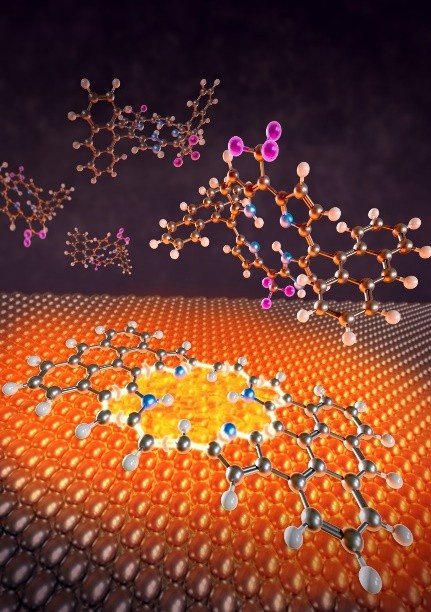
Upon deposition onto a hot gold surface, a porphyrin undergoes an unprecedented skeletal rearrangement in which carbon atoms are inserted into the macrocycle, expanding its aromatic 18-π circuit into an antiaromatic 20-π porphyrin. Image: Patricia Bondía. |
- Researchers modify the distribution of electrons in the core of a porphyrin and create a new molecular architecture, switching its electronic properties from aromatic to anti-aromatic.
- This work opens up new possibilities for the design of porphyrin-based molecular materials with unprecedented electronic and coordination properties.
- The study has been featured on the front cover of the journal Angewandte Chemie International Edition.
| Tweet |  |
Press release download |
Madrid, 3th september, 2026. Porphyrins are molecules that are essential both for life and for numerous emerging technologies. They are present in fundamental biological processes — such as the transport of oxygen by hemoglobin or the absorption of light by chlorophyll — but they also form a key platform for the development of chemical sensors, catalysts, optoelectronic devices and energy conversion systems. Precisely modifying the structure of these molecules to endow them with new properties remains one of the major challenges in molecular chemistry.
A team of researchers at IMDEA Nanociencia, the Complutense University of Madrid, the Institute of Physics of the Czech Academy of Sciences, and the ICMM-Institute of Materials Science in Madrid has developed a pioneering strategy to expand the core of a porphyrin directly onto a metallic surface, an approach inspired by covalent synthesis on surfaces. The work demonstrates, for the first time, the controlled conversion of an 18-π-electron porphyrin into an expanded 20-π-electron porphyrin through the insertion of two carbon atoms into the macrocycle.
In cyclic molecules such as porphyrins, the number of π electrons determines their aromaticity, a property that greatly influences their stability and electronic behaviour. With 20 π electrons, the molecule becomes anti-aromatic, a rather unstable state, but one that can confer very interesting electronic properties, such as a smaller band gap or greater reactivity. This is precisely what makes this work so interesting: the researchers have succeeded in transforming a ‘conventional’ porphyrin with 18 π electrons into one with 20 π electrons directly on a metal surface. The surface stabilises this unusual structure, allowing its properties to be studied and paving the way for new molecular materials.
The research, led by Ana Barragán, Aurelio Gallardo, Nazario Martín and David Écija, synergistically combines organic synthesis with local probe microscopy and spectroscopy, supported by theoretical calculations to confirm the new structure and reveal its unique electronic properties, including a narrow band gap of approximately 0.2 eV and the ability to coordinate cobalt atoms via a new coordination motif. “This work demonstrates that surface chemistry provides access to molecular architectures that are very difficult, or even impossible, to obtain using conventional methods in solution,” said PhD researcher Alba García Frutos, an author of the paper whose thesis focuses on π-conjugated systems on surfaces. The expansion of the macrocycle preserves its planar geometry on the surface, favouring a high degree of anti-aromaticity according to theoretical calculations—a characteristic of great interest for the development of molecular materials with tailor-made electronic properties. Furthermore, the possibility of designing new coordination centres opens up opportunities for future applications in sensors, catalysis and functional optoelectronic materials, consolidating the potential of surface science to construct complex molecules with atomic precision.
The results have been published in the journal Angewandte Chemie International Edition, one of the most prestigious international publications in the field of chemistry. In recognition of the significance of this breakthrough, the research has been featured on the front cover of the journal.
Keywords: (anti)aromaticity, π electrons, porphyrins, surface synthesis
Glossary:
- π Electron: π (pi) electrons are the electrons that participate in π bonds, a type of chemical bond that forms when two atoms share electrons through the lateral overlap of p orbitals. π electrons are usually delocalised; in other words, they can be distributed throughout a molecule. This delocalisation gives them very special electronic properties, such as greater conductivity.
- Aromaticity: a situation in which the cyclic delocalisation of electrons in conjugated systems leads to exceptional electronic stabilisation and characteristic electronic and magnetic properties.
- Anti-aromaticity: a situation in which the cyclic delocalisation of electrons in conjugated systems leads to electronic destabilisation.
Reference:
A. Barragán, E. Pérez-Elvira, and A. García-Frutos, et al., Angewandte Chemie Int. Ed. 65, e25787 (2026). DOI: https://doi.org/10.1002/anie.202525787
Link to IMDEA Nanociencia Repository:

Contact:
David Écija
This email address is being protected from spambots. You need JavaScript enabled to view it.
Nanoarchitectonics on Surfaces Group
https://nanociencia.imdea.org/nanoarchitectonics-on-surfaces/group-home
IMDEA Nanociencia Dissemination and Communication Office
This email address is being protected from spambots. You need JavaScript enabled to view it.
+34 91 299 87 12
LinkedIn: /imdea-nanociencia
Bluesky: @imdeananociencia.bsky.social
Twitter: @imdea_nano
Instagram & Facebook: @imdeananociencia


Source: IMDEA Nanociencia.
IMDEA Nanociencia Institute is a young interdisciplinary research Centre in Madrid (Spain) dedicated to the exploration of nanoscience and the development of applications of nanotechnology in connection with innovative industries.